Up-counter with enable
Build a 4-bit up-counter. Use synchronous active-high reset. Increment when en=1, wrap from 15 to 0, and hold the count otherwise.
Proven equal to a reference for every input sequence and every cycle after reset, by induction. If induction cannot finish, the result says it only covered the first 40 cycles.
Three parts,
all free.
Graded problems
Write Verilog in your browser and submit it. A formal solver checks it against a reference model. If it fails, you see the exact cycle where it differs.
Start practicing →An RTL-to-GDS IDE in your browser
Edit, simulate, synthesize, and view your design as a schematic and a layout. Place, route, check timing, calculate power, and inspect 2D and 3D layouts on the gf180mcuD PDK.
Open Studio →Transistor circuits in your browser
Draw schematics with fast hotkeys or write SPICE netlists. Simulate with ngspice on real gf180 transistor models. View node voltages and transistor regions directly on the schematic.
Open Lab →From code to layout.
This is the real thing.
- 01Write RTL
An editor with your design and its testbench, and one button to run the whole flow.
- 02See the schematic
Your Verilog drawn as logic, so you can check it is what you meant.
- 03Look at the layout
The finished GDS of tiny8, an 8-bit CPU on gf180mcuD, displayed layer by layer.
- 04Check the timing
Real OpenSTA results: slack for every path, and total power.
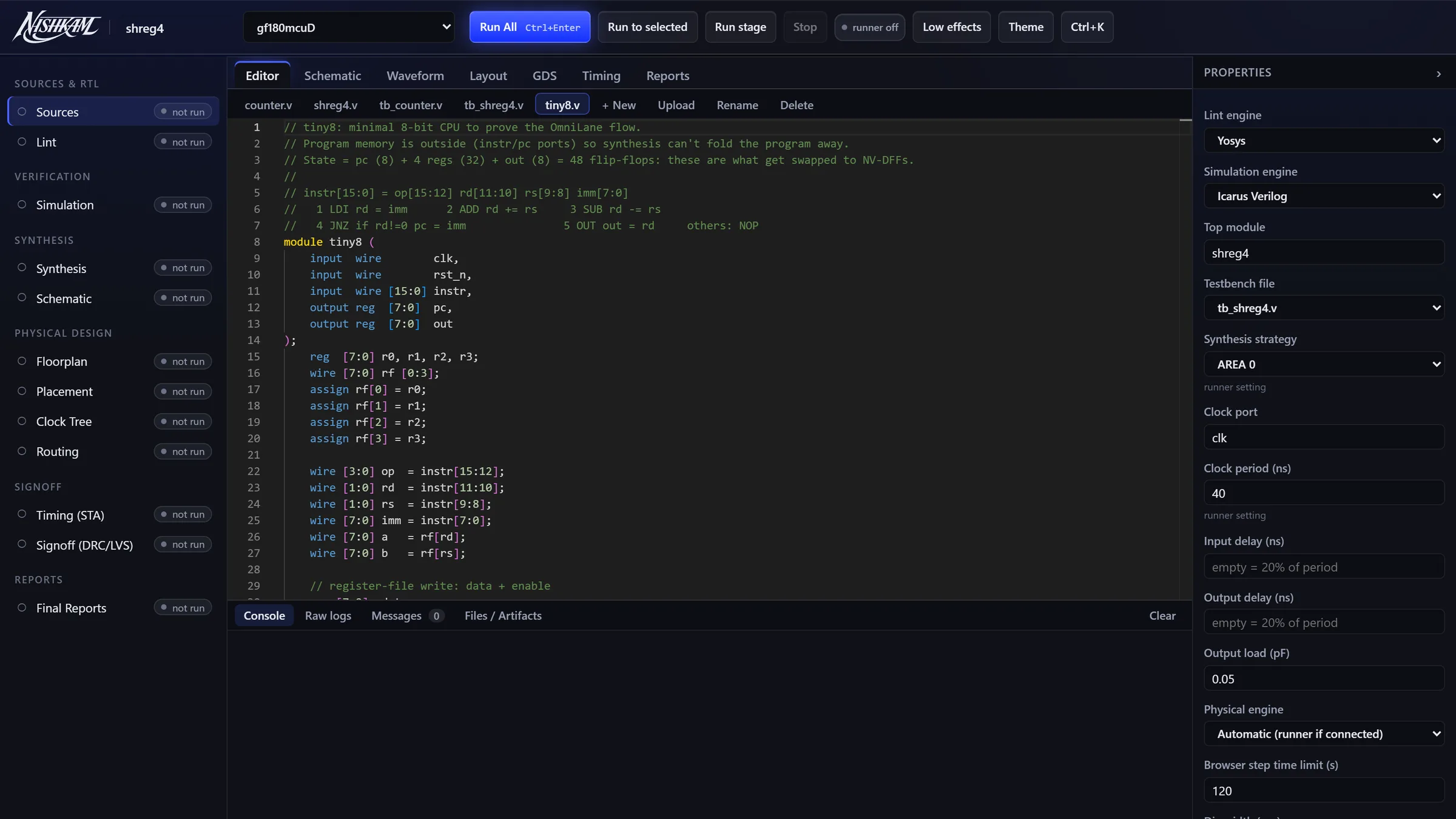
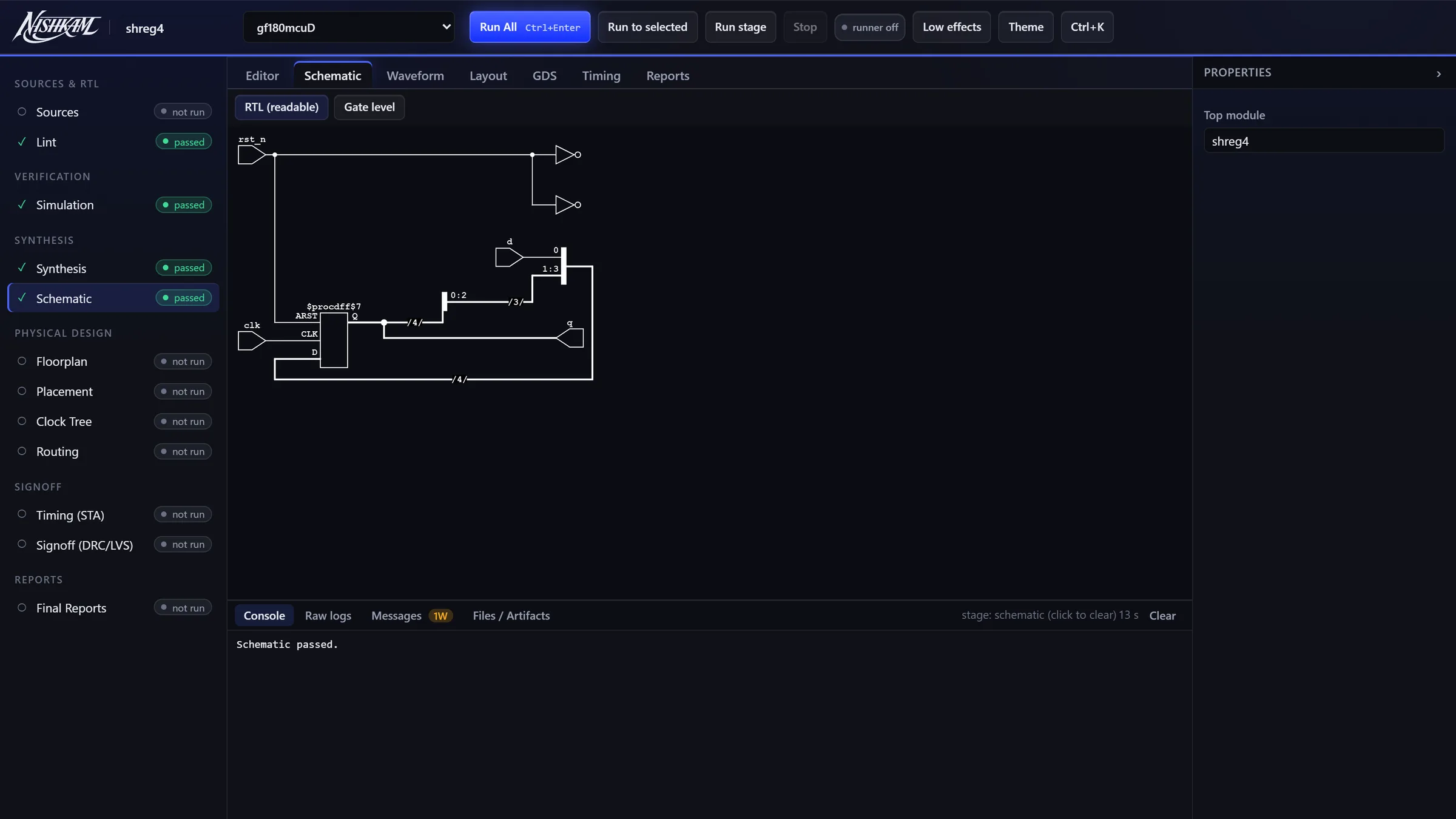
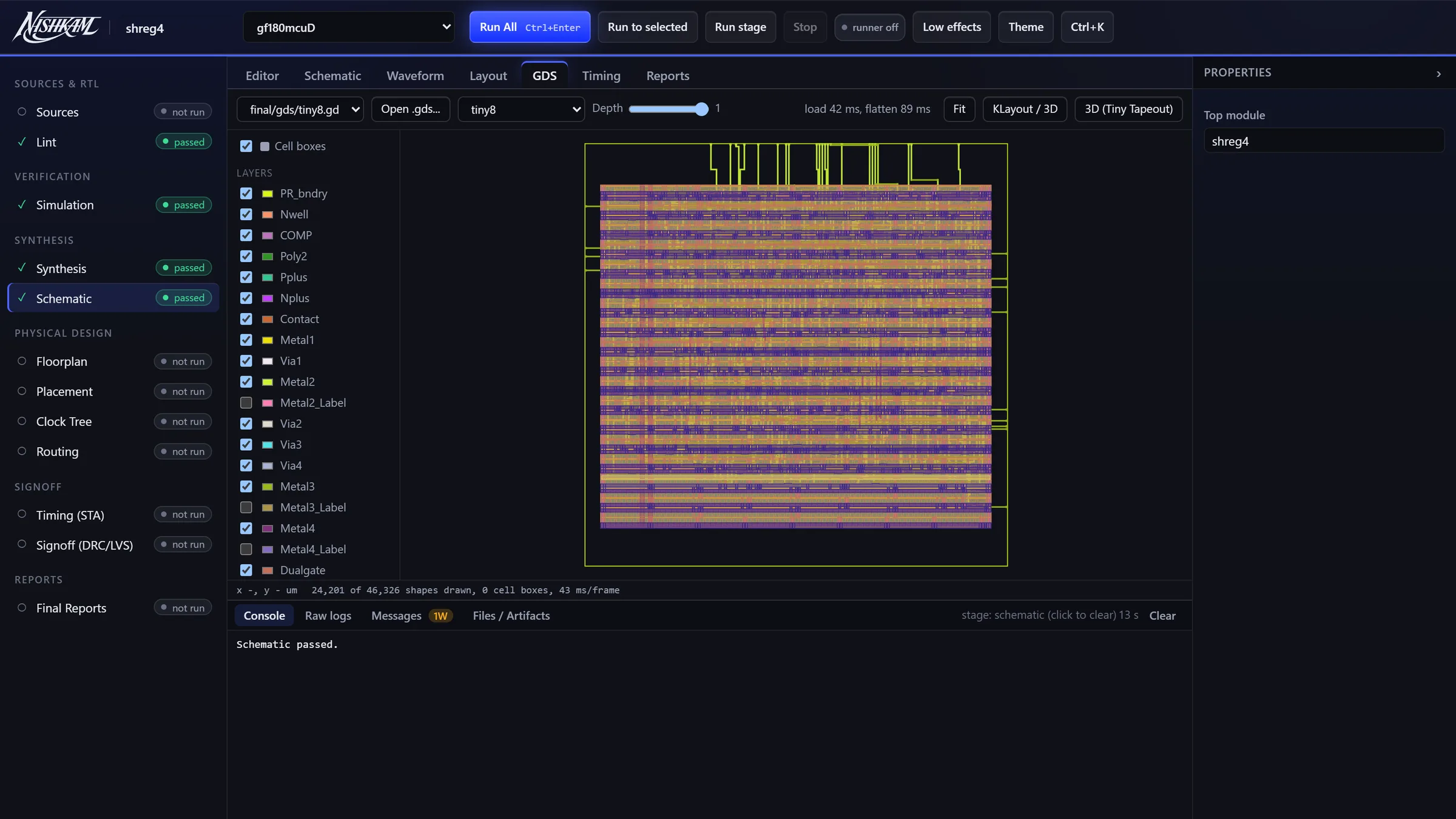
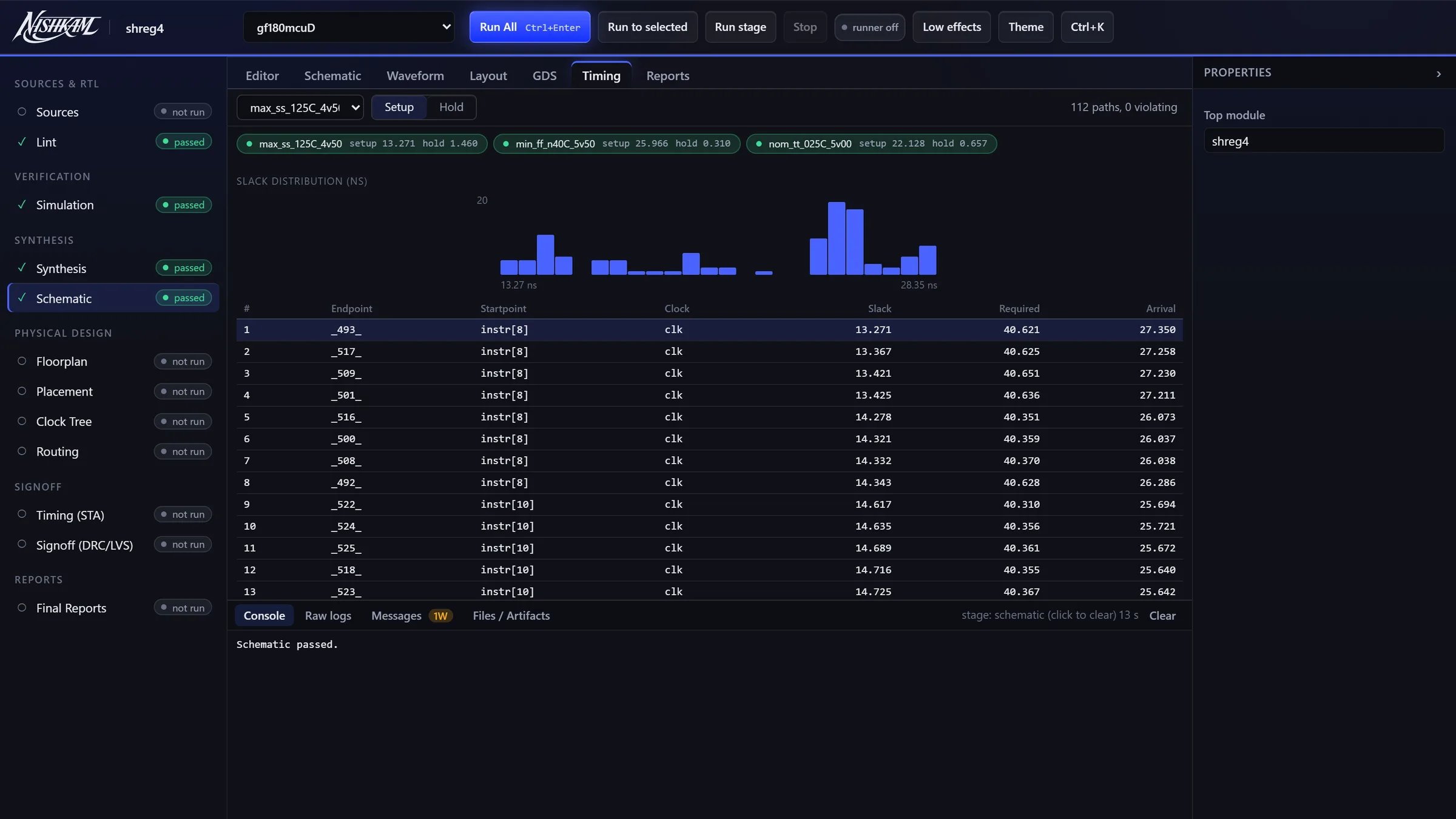
Screenshots of Studio. The layout and timing come from a real run of tiny8.
A chip is a stack.
Scroll to pull it apart.
A real layout made in Studio: tiny8 on the open gf180mcuD PDK. Each layer shows the real shapes, simplified to render smoothly.
Chip companies cannot hire
trained designers fast enough.
Learning IC design usually starts with a huge install. The open-source tool container we check Nishkam against is 25.2 GB. Many students and self-learners never get past that first step.
Nishkam starts with a link. It is free, it runs in your browser with nothing to install, and it uses the real IC design flow, from RTL to layout.
Three simple steps.
Real problems
Write Verilog or build circuits in your browser. The problems are written by a working IC designer.
Checked, not sampled
For digital code, a solver proves your design matches the reference for every input and cycle after reset. If a full proof cannot finish, it checks the first 40 cycles and tells you. In Lab, ngspice simulates analog operating points and transient responses.
Take it to silicon
Turn working RTL into a real layout in Studio: synthesis, placement, routing, and signoff checks on gf180mcuD.
Every input.
Every cycle.
Your Verilog and a reference are checked by Yosys' SAT solver in your browser. If the proof succeeds, they match for every input. If not, it checks the first 40 cycles and says so. A failure gives you the exact input sequence that broke it.
Cycle 13: expected 10, yours 0. Your counter wraps at 9.
Start anywhere.
From counters to chip area.
The digital flow, step by step.
Everything here runs in your browser.
| Stage | Tools | Made by |
|---|---|---|
| Lint | Yosys, Verilator (verilator-wasm) | YosysHQ · Wilson Snyder |
| Simulation | Icarus Verilog, Verilator, xezim | Stephen Williams · Wilson Snyder |
| Waveforms | Surfer | Linköping University |
| Synthesis | Yosys + ABC, gf180mcu 7-track cells | YosysHQ · cells: Google + GlobalFoundries |
| Schematic | netlistsvg + ELK | Neil Turley |
| Placement | OpenROAD (default), graywolf | The OpenROAD Project · Yale University (TimberWolf) |
| Clock tree | OpenROAD TritonCTS (WebAssembly) | Mateus Fogaça, UFRGS |
| Routing | OpenROAD (default), qrouter | The OpenROAD Project · Tim Edwards |
| Timing | OpenSTA: timing and power, before and after routing (wires from Magic) | James Cherry, Parallax Software |
| DRC · GDS | Magic | UC Berkeley (Ousterhout and students); kept up by Tim Edwards |
| RC extraction | Magic (wires to SPEF, for timing) | as Magic above |
| LVS | Netgen | kept up by Tim Edwards, Open Circuit Design |
| Layout view | KLayout (kwasm) 2D / 3D · Tiny Tapeout Explorer 3D | Matthias Köfferlein · Alexander Mordvintsev |
Nishkam gives back: we found and reported a bug in Netgen (netgen#111), fixed upstream in 1.5.325.
All open source. PDK: GlobalFoundries gf180mcuD.
What we are investigating next.
Research directions, not promises. We will add them as they prove useful.
निष्काम (nishkām): doing the work fully, without craving the reward.